

Crypto transaction status UI, torn down on a failed USDT transfer
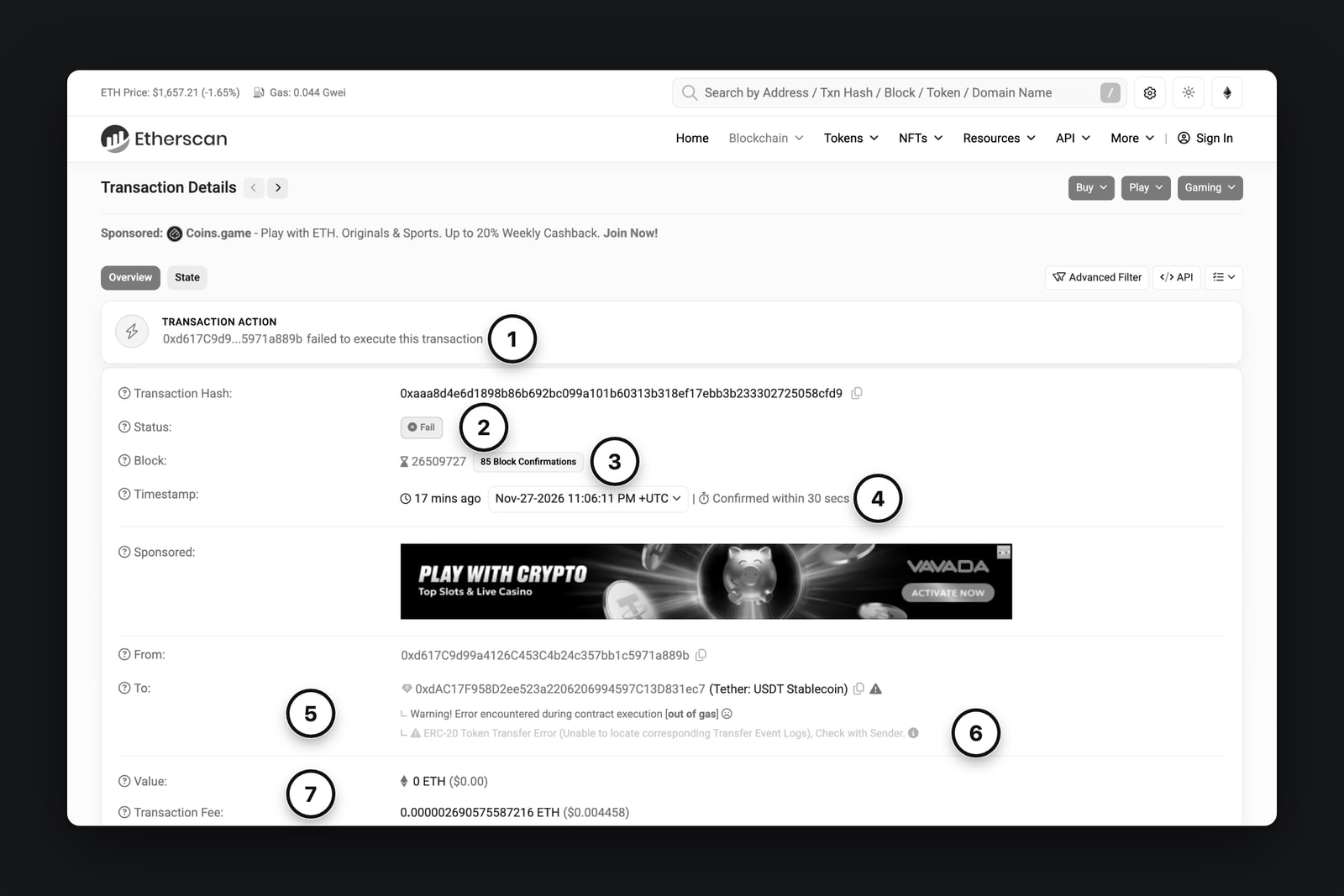
A crypto transaction status screen is the page that tells a person what happened to a transfer they signed: whether it went through, whether it can still change, what it cost and what to do next. A failed transfer is where that page gets tested, because the money did not move and the fee did.
We tore down one such page. On 27 November 2026 at 23:06:11 UTC, an Ethereum account sent a transaction to Tether's USDT contract to move 0.0001 USDT. It failed. We opened its page on Etherscan, the block explorer most wallets link to behind "view on explorer", and shot it at 23:23 UTC, seventeen minutes later. The seven notes below follow the page from the top and match the numbers on the cover.
Etherscan is a reference tool for anyone reading the chain, and a lot of this page works. The notes ask a narrower question: what does the person who just sent money learn here, and what does a wallet team take from it for its own transaction screen.
What Etherscan's failed transaction page shows, note by note
1. The action line says it in a sentence
The first thing under the title is a sentence: "0xd617C9d9...5971a889b failed to execute this transaction." That works. A sentence reads faster than a field label, and it puts the outcome above the hash. What it leaves out is the object. It names the sender's address, which the sender rarely recognises, and it doesn't say what was tried. "A transfer of 0.0001 USDT failed" is the sentence the person was waiting for. The token and the amount are on the page, but much further down, in the decoded input data.
2. Status: Fail, in a word and an icon
The status is a badge with a cross and the word "Fail" on a red tint. The word carries the state, so it survives a greyscale screen or a reader who doesn't see red, which is what WCAG's use of color criterion asks for. Etherscan keeps three states in this slot, Success, Fail and Pending, in the same place on every transaction. That consistency is worth copying. The word itself is clipped: "Failed" describes something that happened to the transfer, "Fail" reads like a column value.
3. 85 block confirmations
Beside the block number, a chip counts 85 confirmations. On a success a rising count reassures. On a failure it answers a question nobody asked. The sender needs the consequence: this is final, nothing more will happen, it's safe to try again. An Ethereum block is final after about 12.8 minutes, two epochs of 32 slots of 12 seconds, as ethereum.org explains. Eighty-five blocks is 17 minutes, so this failure was final before we shot the page. The data to say "Final" is there. The page shows a count.
4. "Confirmed within 30 secs" beside a failure
The timestamp row gives a relative time, the exact UTC time behind a dropdown, and "Confirmed within 30 secs". Next to a failure, that phrase reads as good news. In the chain's vocabulary, confirmed means included in a block, and a failed transaction is included like any other. In a person's vocabulary, confirmed means it worked. A status screen has to keep the two apart: included and succeeded are separate facts, and a failure is the one case where they disagree.
5. The reason, in protocol words
Under the recipient, a red warning line reads "Error encountered during contract execution [out of gas]". The reason is on the page, which many wallets never manage. It's written for a developer, though. Out of gas means the gas limit set at signing was too low for the work, and the page confirms it further down: the transaction used 53,647 of its 53,647 gas, 100 percent. The fix sits on Etherscan's own help page: send it again with a higher gas limit. Nielsen Norman Group's error message guidelines ask for that pairing on the screen itself, the problem in human words and a remedy that costs little to act on. Here the remedy lives on another site.
6. "Check with Sender"
A second line, in amber, adds "ERC-20 Token Transfer Error (Unable to locate corresponding Transfer Event Logs), Check with Sender." Two messages in two colours describe one event, and the second sends the reader to the sender. That helps a recipient who was promised a payment. For the sender, the person most likely to open this page from a wallet, it points back at themselves. An explorer can't know who is reading. A wallet can, and should write the line for the person holding it.
7. Value 0 ETH, fee $0.004458
The value row reads "0 ETH ($0.00)", because a token transfer carries no ETH; the 0.0001 USDT appears only in the input data. The fee row reads 0.000002690575587216 ETH, $0.004458 as the page shows it. Read together, the two rows hold the most useful fact on the page, and neither puts it in words: the USDT never left the account, and the fee did. Etherscan's help page says it plainly, the funds stay in the sender's wallet and the gas fee is still deducted, and MetaMask's support says the same. The transaction page leaves the reader to work it out from a zero and an 18-decimal number.
Why a wallet team should care about an explorer's page
Most wallets show a one-word status in their activity list and link to an explorer for the rest. The explorer becomes the wallet's error screen, written by someone else, for every reader at once. Etherscan serves developers, recipients, analysts and senders with one page, and for that job it is dense and accurate. A wallet serves one person who just signed, and it knows what they meant to do. That knowledge is what turns the seven notes into a better screen.
We made the same case for the moment before the signature in fees on the send screen. The status screen is the moment after it.
What a transaction status screen should say after a failure
- Lead with what was tried, in the person's terms. Token, amount, the recipient's saved name: "Sending 0.0001 USDT to Alex failed."
- Say where the money is. "Your USDT is still in your wallet." It's the first question after a failure, so it gets the second line.
- Say what it cost. "The network fee of $0.0045 was paid", in the person's currency first and the token amount on tap. A fee that a failure hides turns up later as an unexplained drop in the balance.
- Give the reason and the next step together. "The fee limit was too low for this transfer. Try again with a higher limit", with a button that opens the send screen filled in and the limit already raised.
- Keep included apart from succeeded, and say final. Use "confirmed" for successes only, or drop it. A failure gets "Final: nothing more will happen" once the chain says so.
The same vocabulary covers the other states. Pending says what is being waited for and how long that usually takes; spinner or progress bar is the choice we covered in skeleton, spinner or progress bar. Replaced needs a word of its own. When a person speeds up or cancels a pending transfer, the wallet sends a new transaction with the same nonce, as MetaMask's guide describes, and the old one never lands. A screen that then shows the old one as failed, or as missing, alarms the person who did exactly what the wallet offered.
What this teardown does not say
One page, one transaction, one evening. Etherscan's layout changes, and a successful or pending transaction has other rows. The slot between the timestamp and the parties held a sponsored banner when we shot it; it changes with each load and is not part of these notes. We read nothing into who sent the transaction or why. The page shows an account on its first transaction, nonce 0, trying to move a very small amount, and that is all it shows.
Sources
- Etherscan: the transaction torn down here
- Etherscan Information Center: What are the reasons for failed transactions?
- MetaMask Support: Why did I pay gas fees for a failed transaction?
- MetaMask Support: How to speed up or cancel a pending transaction
- ethereum.org: Single slot finality
- Nielsen Norman Group: Error-message guidelines
- W3C: Understanding WCAG 2.2, Use of Color
Frequently asked questions
Because the network did the work. Validators included the transaction in a block and ran it until it failed, and the fee pays for that computation whatever the outcome. On Ethereum the amount you meant to send stays in your wallet; only the gas fee leaves. Etherscan and MetaMask both say this in their help pages. A wallet should say it on the failure screen itself, with the amount paid.
It cannot be reversed, and there is nothing to reverse: the transfer itself never happened. Once the block is final, after about 12.8 minutes, the failure is permanent. To retry, you send a new transaction, and for an out of gas failure it needs a higher gas limit. A good wallet offers that retry as one button, with the send screen filled in and the limit raised.
Confirmed means the transaction is in a block; successful means it did what it was meant to do. A failed transaction is confirmed too, which is why explorers can show "confirmed" next to "fail". People read confirmed as success, so a wallet should keep the word for transfers that worked, or not use it, and show finality separately once the chain reports it.
Related articles
November 25, 2026 · 7 min read
November 24, 2026 · 9 min read
May 21, 2026 · 8 min read