
Crypto wallet fees belong on the send screen, before the signature
Fee display before the signature is the part of a crypto wallet's send screen that tells a person, in their own currency, what the transaction will likely cost, the most it can cost and what the recipient gets, all before they sign. Done well, people send without a second look. Done badly, the first place they see the real fee is a block explorer, after the money has moved.
We design send screens for wallets, exchanges and payment apps, and the fee line is where most of the decisions sit. This piece covers why that number is hard to show, which parts it has on Ethereum, on a layer 2 and on Solana, and how one screen carries all of it without turning into a gas calculator.
Why is the fee the hardest number on a send screen?
Every other number on the screen is settled when the person reads it. The amount is what they typed. The address is what they pasted. The fee is a forecast: the network sets it when the transaction lands in a block, and that happens after the signature.
Three things make the forecast hard to read.
- It moves while the screen is open. On Ethereum the base fee can rise by up to 12.5% from one block to the next (the change denominator of 8 in EIP-1559), and a new block comes every 12 seconds.
- It is often paid in another asset. Sending 1,250 USDC on Ethereum costs ETH. Someone who holds USDC and no ETH cannot send at all, and the screen has to say so before they try.
- It has more than one part. A network fee, sometimes a data fee paid to another chain, sometimes the app's own fee. Each one goes to someone different.
A wallet that shows one gwei figure, or one speed label, leaves all three for the person to work out alone.
What does a crypto transaction actually cost?
The parts change from chain to chain. These are the ones a send screen meets most often.
Ethereum: likely, and at most
Since EIP-1559 went live in August 2021, an Ethereum transaction carries two prices per unit of gas: a max fee and a max priority fee, the tip. The network charges the block's base fee, which is burned, plus the tip, which goes to the validator, and never more than the max fee. The gap between the max and what was charged stays with the sender, and so does any gas the transaction did not use (EIP-1559).
So every Ethereum send has two honest numbers. One is what it will likely cost at the current base fee. The other is the most it can cost if the base fee climbs before inclusion. A common default in wallet libraries sets the max at twice the base fee plus the tip, and the arithmetic explains why: 1.125 to the sixth power is about 2.03, so a doubled base fee survives six full blocks in a row, a little over a minute of rising prices.
Layer 2: a second fee, priced by Ethereum
On an OP Stack chain such as OP Mainnet, the total is an execution fee, plus an L1 data fee for publishing the transaction to Ethereum, plus an operator fee on chains that set one (Optimism docs). The L1 data fee depends on the transaction's size and on Ethereum's price for data at the moment of inclusion. Since the Dencun upgrade of March 2024 that data can travel in blobs, which have a fee market of their own (EIP-4844).
For the screen, this means a layer 2 fee can be a few cents and still move between the quote and the block, because part of it is priced on another chain.
Solana: per signature, plus priority
A Solana transaction pays 5,000 lamports per signature, plus an optional prioritization fee: a price per compute unit multiplied by the compute unit limit the transaction requests (Solana docs). The limit requested counts, not the units used. A wallet that leaves a high default limit makes the person pay for room the transfer never needed.
The app's own fee
On top of the network sits whatever the product charges: a swap spread, a fee on sends, a margin for paying gas on the person's behalf. It is the one part the team decides, and the one a person forgives least when they find it later.
Why a speed picker does not answer the question
Many wallets put a choice of speeds on the send screen: low, market, aggressive. The labels describe a strategy, wait longer and pay less or pay more to be included sooner, and wallets' own help pages explain them that way (MetaMask, gas settings). They help people who already know what a base fee is.
The person sending rent in USDC asks something simpler: how much will this cost me, in money I understand. A speed picker answers only after a second step, and it asks for a decision before giving the answer. A fee in gwei, or in ETH with eight decimals and no conversion, has the same problem.
What should the send screen show before the signature?
Six things, in the order a person reads them.
1. One total in the person's currency, likely and at most
Show the likely fee as the main number and the ceiling right under it: "about $1.71, at most $3.49". The ceiling is what the wallet signs, so it is what the person agrees to. Leaving it out makes the screen look cheaper and the signature less honest.
2. The asset that pays the fee, and whether the balance covers it
Name it ("paid in ETH") and check it against the balance before the button turns on. When someone sends their whole ETH balance, take the maximum fee off the amount and say so on the screen. Otherwise the transaction fails for lack of funds after they sign.
3. The app's fee on a line of its own
Name it, give its rate and show it when it is zero. A zero on its own line is information; a missing line reads as something held back. For a crypto-asset service provider authorised under MiCA, Article 66(4) already asks for the policies on pricing, costs and fees to be published in a prominent place on the website (ESMA, MiCA Article 66). Whether that rule covers a given product is a question for a lawyer. The send screen is where the person reads the fee either way.
4. What the recipient gets
"Recipient gets 1,250.00 USDC." When the fee comes out of the amount sent, this line differs from the amount typed, and it is the line the recipient will check.
5. How old the quote is
The fee is a quote taken at one block. Show its age, refresh it with every block, and when it rises past the ceiling the person agreed to, ask again before signing. "Checked 4 s ago" takes one line.
6. The same numbers the signer shows
A hardware wallet or a browser extension shows its own confirmation, usually with the maximum. If the app said $1.71 and the device asks for 0.001125 ETH at most, the person sees two answers to one question. Use the same ceiling in both, and show it in the app first, so the device confirms a number the person has already read.
What this looks like on a send screen
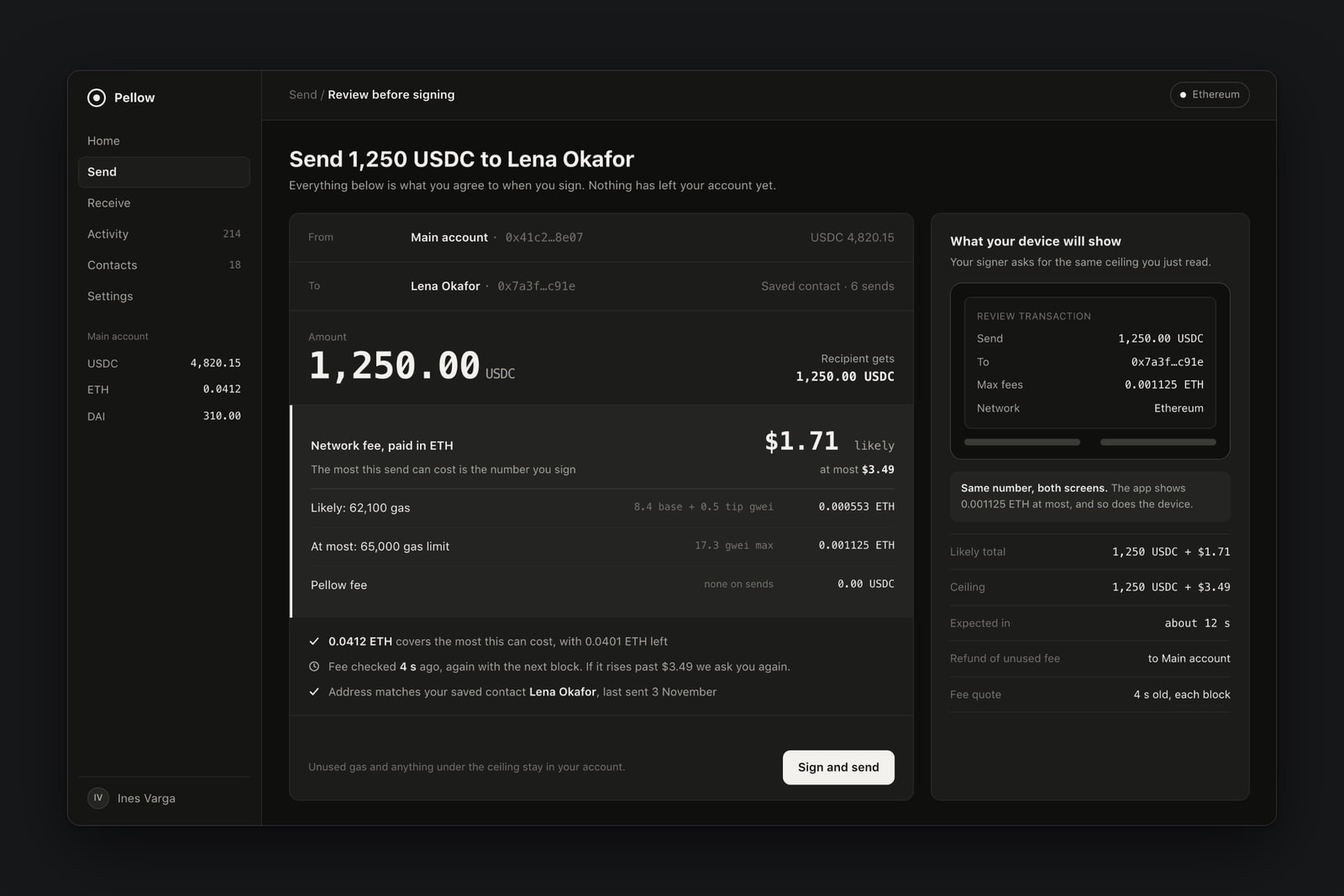
The cover of this article is the send screen of Pellow, a wallet we drew for it. Ines Varga sends 1,250 USDC on Ethereum. The amount panel shows the 1,250.00 she typed and, under it, "Recipient gets 1,250.00 USDC". Then one fee row: about $1.71, at most $3.49, paid in ETH.
Opened, the row splits into its parts. The likely 0.000553 ETH is 62,100 gas at an 8.4 gwei base fee and a 0.5 gwei tip. The ceiling of 0.001125 ETH is a 65,000 gas limit at a max of 17.3 gwei, twice the base fee plus the tip. Below them sits "Pellow fee: none on sends". One line checks the balance (0.0412 ETH, enough for the ceiling) and one gives the quote's age. The button reads "Sign and send", and the device that follows asks for the same 0.001125 ETH.
Nothing on that screen needs new technology. It is the estimate every wallet already computes, written for the person who pays it.
Where teams get the fee line wrong
- The fee appears after the signature. A fee first seen on the receipt reads as a charge nobody agreed to.
- Only the likely number. The person agrees to $1.71 and the device asks for up to $3.49.
- The app's fee folded into the network fee. It saves a row and costs trust the day someone compares it with an explorer.
- The gas error arrives after signing. "Insufficient funds for gas" belongs before the button, as a plain sentence with a way out; the same rules hold as for any error state.
- Pending shown as done. A sent transaction waits for a block, and a wallet that shows it as final too early is making a promise only a real undo could keep (optimistic UI).
The fee line is small. It is also the last thing a person reads before money leaves for good, and on a chain there is no chargeback to fix it afterwards.
Sources
Frequently asked questions
On Ethereum the wallet signs a ceiling, the max fee, and the network charges only the block's base fee plus the tip. The difference stays in the account, and so does any gas the transaction did not use. If the screen showed only the ceiling, the real charge will almost always be lower. That is why a send screen should show both numbers: the likely one and the most it can be.
Both, with the person's own currency first. Most people judge a cost in the money they earn and spend, so the main number is in dollars, euros or whatever the account is set to. The asset amount goes beside it, smaller, because it is what the signing device will show. The conversion rate has an age too, and it belongs in the same line as the fee quote.
Yes. With account abstraction under ERC-4337, a contract called a paymaster can pay a transaction's gas, so a person can send USDC without holding ETH. The send screen should still show the fee line and say who pays it, for example "Network fee: paid by the app". If the app recovers that cost through a spread or a fee elsewhere, that cost belongs on the same screen.
Related articles
August 31, 2026 · 9 min read
September 13, 2026 · 9 min read
April 29, 2026 · 9 min read