
 Infra
InfraBrand mentions vs backlinks: what predicts AI citations in 2026
Ahrefs measured 75,000 brands: branded web mentions correlate 0.664 with AI visibility, backlinks 0.218. Here is what that changes in the work.
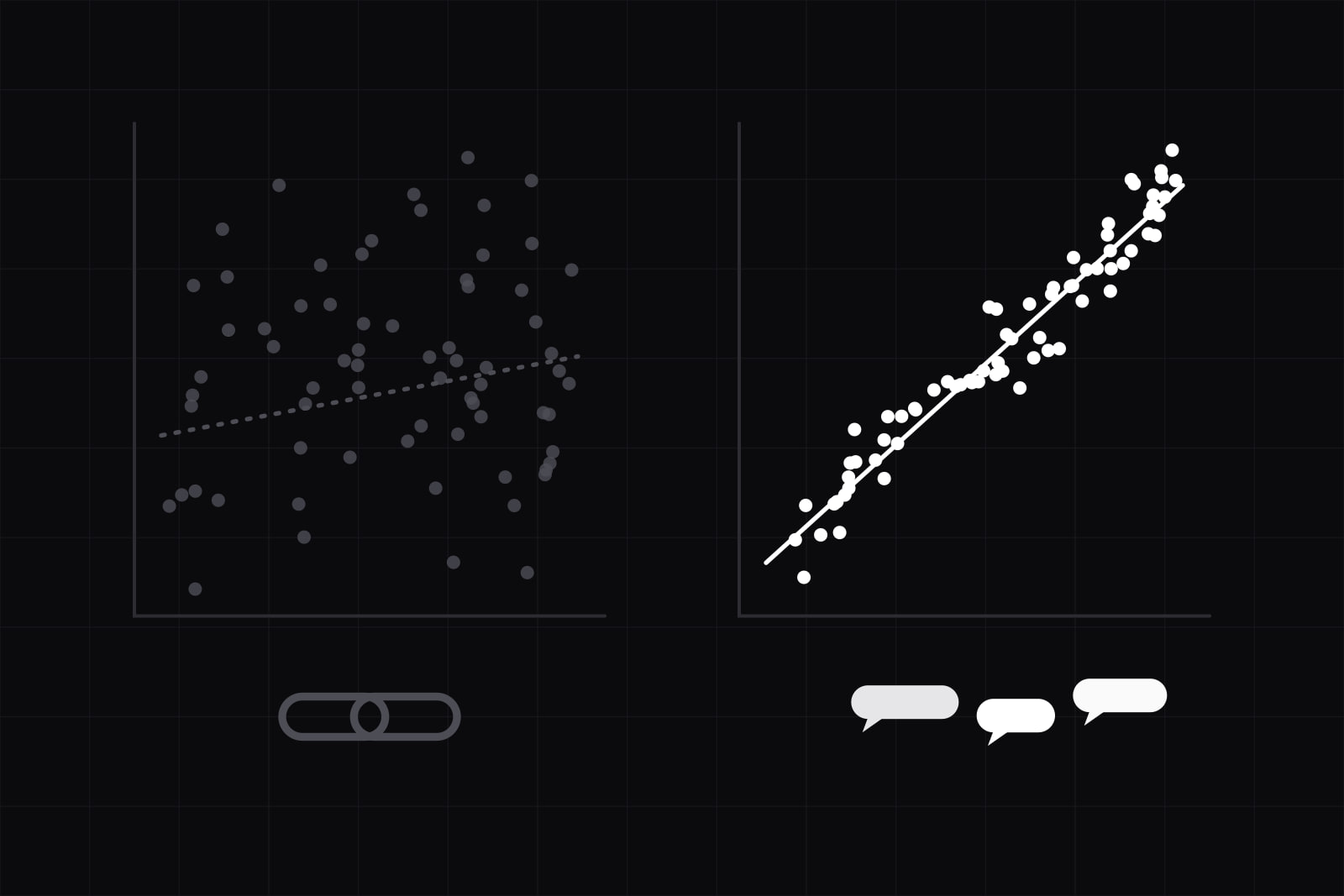
The domain rating has gone up for two years straight. The link budget got spent. And when a buyer asks ChatGPT for a shortlist in your category, your name still does not come up. That gap now has a number attached to it. Ahrefs measured 75,000 brands and found that branded web mentions correlate with AI visibility at 0.664. Backlinks correlate at 0.218. Three times the signal, from the input most teams never put on a budget line.
What the 75,000-brand study measured
Ahrefs compared brand visibility across Google AI Overviews, Google AI Mode and ChatGPT against the usual SEO signals plus a set of brand signals. The three strongest predictors were all off-site, and all of them were brand-shaped rather than link-shaped: YouTube mentions at 0.737, branded web mentions at 0.664, branded anchor text at 0.527. Brand search volume came in at 0.392. Backlink counts and URL rating landed at the bottom of the table, around 0.218.
The gap moves by platform. Branded web mentions correlate at 0.709 with AI Mode, 0.664 with AI Overviews, 0.656 with ChatGPT. Of the three, AI Mode leans hardest on brand signals. And the volume effect is not gentle: brands in the top quartile for web mentions earn up to 10 times more AI Overview mentions than the quartile directly below them. Ahrefs published the full correlation table.
Correlation is not causation, and the difference is expensive
Ahrefs said this themselves, and it needs saying again before anyone opens a YouTube channel on Monday morning. Brands with high AI visibility also have wide presence across platforms. The data does not show that the presence produced the visibility. The likelier reading is that both come from the same place: brand authority as a composite signal, absorbed by models from training data and from live retrieval.
So the honest version of the finding is narrower than the headline. Nobody manufactures 0.664 worth of correlation by seeding forum posts. What the number does support is a change of target: stop treating link acquisition as the only off-site lever, and start counting the thing that tracks better with the outcome you want.
Why link metrics keep underperforming as an AI signal
A second Ahrefs study came at this from the domain side. It took the 50 most-mentioned websites in Brand Radar for Google AI Overviews, ChatGPT and Perplexity, across roughly 76.7 million AI Overviews, 957,000 ChatGPT prompts and 953,500 Perplexity prompts in June 2025, then checked mention counts against Ahrefs Rank.
Perplexity showed a moderate correlation. Google AI Overviews showed a very weak one. ChatGPT showed none at all. The direction surprised the researchers, who had expected Google to lean harder on its own classic ranking signals than Perplexity does. The domain-level analysis is here.
The mechanism is not mysterious. A backlink is a machine-readable vote cast between two pages. A mention is a sentence a person wrote about you, in language, with context around it. Language models are built on sentences. When a model has to decide whether your company belongs in an answer about billing platforms, a thousand sentences describing you as a billing platform is a stronger input than a thousand anchor tags.
Ghost citations: getting cited is not the same as getting named
There is a second failure mode sitting underneath the first, and it breaks most GEO dashboards. Semrush, working with Kevin Indig, logged 3,981 domain appearances across 115 prompts, 14 countries and four AI search engines. In 62% of cases the engine linked the source and never said the brand's name in the answer. Indig calls these ghost citations.
The split by engine is stark. When a brand appears in a Gemini answer, Gemini names it in the text 83.7% of the time but cites it as a source only 21.4% of the time. ChatGPT does the reverse: an 87% citation rate against a 20.7% mention rate. Optimise for one engine's behaviour and you can go invisible in the other while the dashboard still looks healthy.
One finding from that study is directly actionable. Comparative content produces 2.4 times more brand mentions than informational content. Explainers earn the link. Comparisons earn the name. If your GEO reporting tracks citation rate and nothing else, it will show a rising line while the brand stays anonymous inside the answers. Semrush published the full study.
Where mentions come from when nobody knows you yet
The uncomfortable part of the finding is that mentions are harder to buy than links. There is no marketplace with a rate card. What exists instead, in rough order of how fast it moves:
- Original data. A number nobody else has is the cheapest reason for a stranger to write your name. Run the survey, publish the benchmark, show the method.
- Named presence in comparison content. Review sites, category roundups, alternatives pages. This is where a model finds you described in the same sentence as your category.
- Community answers under your own name. ChatGPT reaches often for Reddit and Wikipedia. Gemini pulls from a smaller pool that also includes Reddit, Wikipedia and YouTube.
- Video. YouTube mentions topped the correlation table at 0.737. The causal story there is weak, but people making videos about a company is a hard signal to fake.
Semrush's 2026 AI Visibility Index, built on 126 million US AI search prompts, points the same way from a different angle. Models cross-check claims against independent sources and avoid leaning on a company's own marketing copy. Several unrelated sources describing you with the same category words is what raises a model's confidence. Your own site cannot supply that, however well it is written.
What we changed
We report mention count next to citation count on every content project now, because the two move independently and only one of them puts a name in front of a buyer. We write more comparison pages and fewer neutral explainers, on the strength of the 2.4x finding. And we treat being written about by other people as work that gets scheduled, not as a side effect of publishing often enough.
None of that replaces the basics. It sits on top of the GEO practices that already move citation rates, and on top of a refresh cadence, because cited content still runs measurably fresher than the organic top ten.
What this does not retire
Backlinks still do the job they always did. They move classic rankings, and classic rankings still feed AI answers: 38% of AI Overview citations pull from the organic top 10. The page has to rank before a mention has anywhere to point. Cutting the link programme on the strength of a correlation table would be reading the study backwards.
The shift is in what gets added, and in what gets counted. A link budget with no mention strategy attached is optimising for a signal that three of the four engines studied barely respond to. Same money, different target: get written about, in sentences, by people who are not you.
Sources
- Top Brand Visibility Factors in ChatGPT, AI Mode, and AI Overviews (75k Brands Studied), Ahrefs
- Domain-Level Link Metrics May Not Be Good Predictors of AI Search Mentions, Ahrefs
- 38% of AI Overview Citations Pull From The Top 10, Ahrefs
- Why 62% of AI citations don't lead to brand mentions, Semrush and Kevin Indig
- Semrush Releases Expanded 2026 AI Visibility Index, Analyzing 126 Million AI Search Prompts
Frequently asked questions
Two categories of tool cover it. Brand monitoring platforms such as Ahrefs Brand Radar and Semrush's AI visibility suite track how often your name appears across the web and inside AI answers. Alongside that, a plain search for your brand name minus your own domain gives you a rough unlinked-mention count for free. Track the number monthly, not weekly. Mention counts move slowly and weekly readings are mostly noise.
Not on this evidence alone. The correlation study says mentions track AI visibility better than links do. It does not say links stopped working, and 38% of AI Overview citations still come from the organic top 10, which links help you reach. The move that survives scrutiny is reallocation at the margin: keep the links that earn rankings on commercial pages, and move the budget that was buying low-quality links into work that gets your name written in sentences.
Nobody has a clean number for this, and anyone quoting one is guessing. The delay depends on which mechanism carries the mention. A page that gets indexed and retrieved live can influence an answer within days. A mention that only matters through training data waits for the next model release, which is measured in months. Plan in quarters, and expect the retrieval path to move first.
No. Those are different jobs. An llms.txt file describes your own site to a crawler that already found you. Mentions are what other people write about you elsewhere, which is exactly the signal a model cannot get from anything you host. Adding llms.txt is cheap and harmless, but do not count it against a mention target.
Related articles
Infra Infra
InfraThe 12 GEO best practices that actually move citation rates in 2026
Twelve GEO practices we apply on every article, with the measured lift from Princeton, Averi, and Search Engine Land citation benchmarks. Design