
Next.js Server Actions in production: patterns we use and avoid
Every Server Action you export is a public POST endpoint with no built-in auth. Here are the Next.js 16 patterns we ship and the ones we refuse.
In this piece
A Next.js Server Action is a server-side function you call as if it were local, which hides the one fact that decides whether your app is safe: every call is a public POST request over the network.
Teams reach for Server Actions because they remove the API layer. A form calls a function, the function writes to the database, the page updates. No route handler, no client fetch, no request contract to keep in sync. That appeal is real, and we ship Server Actions on most SaaS builds. It is also where the mistakes start. The function reads like private code, so it gets treated like private code. It is not. Below are the patterns we run on production Next.js 16 apps, and the ones we refuse, after the framework settled through React 19 and the Next.js 16 caching model.
Why a Server Action is riskier than it looks
When you mark a function with the 'use server' directive and export it, Next.js compiles it into an endpoint. Every action becomes a public POST endpoint with zero built-in authentication, reachable by a direct request and not only through your form. Next.js adds one framework-level guard: it compares the request Origin against the Host (or X-Forwarded-Host) and rejects a mismatch, which blocks basic cross-site POSTs. If you run behind a proxy or CDN on another domain, you list those in serverActions.allowedOrigins. Framework protection stops there. It does not know who your user is, what they own, or whether this row is theirs to touch. As the Next.js security guide puts it, framework protections are not a substitute for application-level checks.
Why "it is just a function" is the wrong mental model
The common fix is to guard the boundary once, in middleware or a layout, and assume everything below is protected. It is not. Middleware runs on navigation, not on every action invocation, and a layout check protects what renders, not what an attacker POSTs directly. Treat each action as its own front door. If you have read our deeper piece on Server Actions security, this is the same rule stated for production teams: the perimeter is per-action, not per-route.
The patterns we use
Validate input with Zod, then check authorization separately
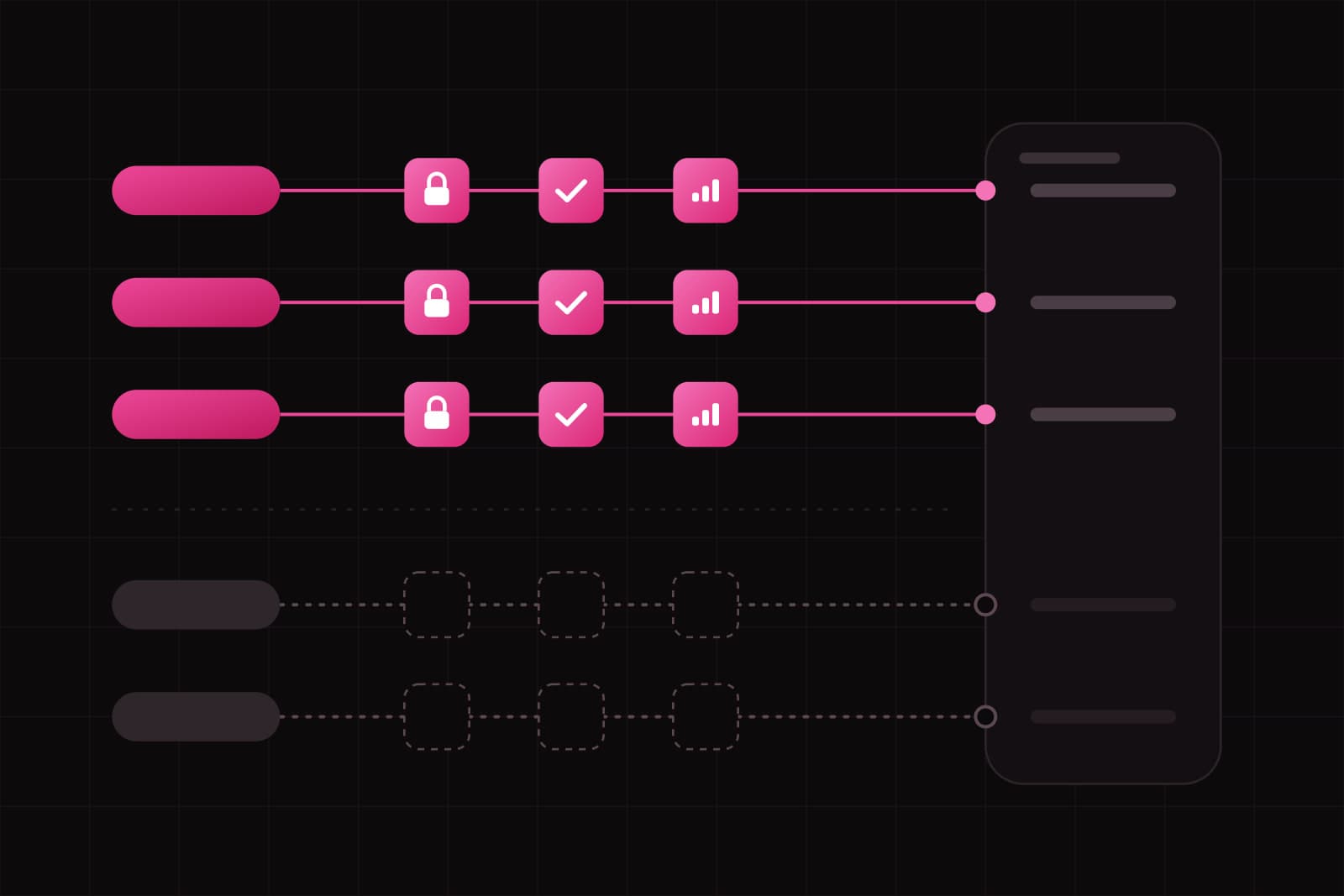
Validation and authorization are different jobs, and confusing them is the most common Server Action bug we see. A well-formed object can still point at a row the caller does not own. So we run both, in order: parse the payload with a Zod schema, then verify the caller is allowed to act on that specific resource.
'use server'
export async function deleteProject(input) {
  const { id } = DeleteSchema.parse(input)   // validation
  const user = await requireUser()           // authentication
  const project = await projects.findById(id)
  if (project.ownerId !== user.id) {         // authorization
    return { ok: false, error: 'not_allowed' }
  }
  await projects.remove(id)
  return { ok: true }
}
Put every read and write behind a Data Access Layer
We keep database access in a server-only Data Access Layer that returns minimal DTOs, never raw rows. The action calls the layer, the layer enforces ownership and shapes the output. That keeps a stray field, a password hash or an internal flag, from leaking into a client component. It also gives you one place to add rate limiting for expensive operations.
Return a typed result, never throw across the boundary
We return a predictable result union from every action, something like { ok: true, data } or { ok: false, error }, rather than throwing. A thrown error crosses the network as an opaque failure the UI cannot render well. A typed result lets the form show the right message and lets TypeScript keep the client and server honest. This is the same discipline we describe in type-safe RPC with Server Actions.
Let React 19 carry the pending and optimistic UX
Server Actions pair with three React 19 hooks. useActionState holds the returned result and gives you progressive enhancement, so a form still works with JavaScript disabled. useFormStatus exposes the pending state for a submit button without prop drilling. useOptimistic updates the UI before the round trip finishes, then reconciles when the real result lands. We reach for optimistic UI on high-frequency, low-risk mutations (toggles, reorders), not on destructive ones.
Pick the right cache invalidation call
Next.js 16 splits cache invalidation into distinct tools, and picking wrong is a silent production bug. Use revalidatePath to refresh a route after a mutation. Use updateTag inside an action when the user must read their own write in the same round trip; it expires the tag immediately and the next request waits for fresh data. Use revalidateTag, now taking a cacheLife profile, for content that can tolerate stale-while-revalidate. Match the call to whether the user needs to see the change now or eventually.
Log every failure you return
Because we return typed failures instead of throwing, an unauthorized attempt or a validation miss can pass silently unless we record it. So each action logs the failure branch with the caller id and the reason before returning it. That turns the result union into an audit trail: repeated not_allowed results from one account is a signal worth an alert, not a red toast only the user sees. It costs one line per action and it is the cheapest observability you will add all quarter.
The patterns we avoid
- Using a Server Action to read data. Actions are POST-only and run in series, not the tool for GET-style reads. Fetch in a Server Component or a Route Handler instead.
- Accepting large uploads directly. Action requests are capped at 1 MB by default. You can raise
serverActions.bodySizeLimit, but for files beyond a few megabytes we use a Route Handler with streaming, or a direct-to-storage upload. - Trusting the client to send the user id. The caller id comes from the session on the server, never from a form field.
- One giant action that does five things. Small, single-purpose actions are easier to authorize, test, and reason about.
- Ignoring the action-id rotation. Next.js rotates Server Action IDs at least every 14 days, so a user on a stale tab can call an id that no longer exists. On self-hosted multi-instance deploys, set a stable
NEXT_SERVER_ACTIONS_ENCRYPTION_KEYacross instances, and handle the "Failed to find Server Action" case with a reload prompt.
What this looks like in practice
On a recent build, a settings form called a single updateWorkspace action. The Zod schema rejected malformed input, the Data Access Layer confirmed the caller was an admin of that workspace, the action returned a typed result, and useActionState rendered the error inline with no page reload. When the write succeeded, updateTag refreshed the workspace name everywhere it appeared in the same response. The whole path is one file, no API route, and it still degrades to a plain form post if a script fails to load. That is the trade we like: less plumbing, on the condition that every action guards its own door.
Server Actions are production-ready in 2026 and they replace most simple API routes for mutations. They do not replace judgment. Validate, authorize, return a typed result, and keep reads out. Do that on every action, not once at the edge, and the invisible network boundary stops being a liability. For where this sits in the wider stack, see what changed in Next.js 16 and React 19.
Sources
Frequently asked questions
Are Next.js Server Actions secure by default?+
Partly. Next.js gives you one framework-level guard: it compares the request Origin to the Host and rejects cross-site POSTs, and it accepts only the POST method. That is not authentication or authorization. Every action you export is a public POST endpoint reachable by direct request, so you must add your own authentication and an ownership or permission check inside each action. Framework protection is a floor, not a wall.
When should I use a Route Handler instead of a Server Action?+
Use a Route Handler for reads, for uploads larger than 1 MB, and for anything a non-browser client calls, like a webhook or a public API. Server Actions are POST-only, run in series, and are capped at a 1 MB body by default. They fit mutations triggered from your own UI. Reads belong in Server Components or Route Handlers, and large file uploads belong in a streaming Route Handler or a direct-to-storage flow.
Do Server Actions work without JavaScript?+
Yes, when you wire them through a form and useActionState. Because the action is a real POST endpoint, the browser can submit the form and get a server-rendered response even if the client script never loads. That is progressive enhancement, and it is one reason to prefer the form-plus-useActionState pattern over calling an action from an onClick handler. Optimistic UI with useOptimistic needs JavaScript, so it is an enhancement on top, not the baseline.
Why do I get 'Failed to find Server Action' after deploying?+
Next.js identifies each Server Action by an id baked into the build, and it rotates those ids at least every 14 days. A user sitting on an old tab from a previous deploy can invoke an id the new build no longer knows, which throws that error. On single-instance hosting a reload fixes it. On self-hosted multi-instance deploys, set a stable NEXT_SERVER_ACTIONS_ENCRYPTION_KEY shared across instances so ids stay consistent, and catch the error to prompt the user to refresh.
Related services
Studio
Start a project.
We write about what we build. Tell us what you want to build.